About IMCS
In spring (2014) the Institute of Mathematics and Computer Science (IMCS) of the Academy of Sciences of Moldova has celebrated its 50 years anniversary. Today we have all the reasons to assert that Institute of Mathematics and Computer Science is a center for advanced research in the domains of pure mathematics, the applied one and computer science.
Institute of Mathematics and Computer Science was formed in 1964 on the base of the mathematics department of the Institute of Physics and Mathematics, founded in 1961. Academician V. Andrunachievici was the founder of the Institute. He was a talented mathematician and organizer who managed to form an advanced team.
The main goals of the institute activity are: maintaining the existent directions of research, development the new directions in correspondence with country necessities, bringing in world science, and preparation of the high qualified specialists.
Throughout the years, the researchers of the Institute have obtained remarkable results in the fields of algebra, functional analysis, differential equations, mathematical logics, computing mathematics, mathematical modeling and computer science. Towards the end of 70- th (XXth century), famous scientific schools in the theory of algebraic rings (the founder is acad. V. Andrunachievici), in the qualitative theory of differential equations (acad. C. Sibirschi), in the theory of quasigroups (cor.m. of Academy of Pedagogical Sciences of the former Soviet Union, Professor V. Belousov), in functional analysis (cor.m. I. Gohberg) and in mathematical logic (Dr. A. Kuzneov) has been formed.
Currently, most mentioned schools continue their successful work and enjoy international authority. Within the framework of these schools, over 3000 of scientific papers and about 150 monographs in different domains of mathematics and computer science have been published. Also 127 volumes from series "Mathematical research" (in Russian "Matematicheskie issledovania") and 15 volumes “Applied mathematics and programming” (in Russian "Prikladnaia matematika i programmirovanie") had appearedю
In the Institute, 30 doctors in habilitation and about 404 PhDs were trained through doctoral study or with contribution of Specialized Scientific Councils. Starting from 1989, the Institute publishes the journal "Buletinul Academiei de Științe a Republicii Moldova. Matematica" (to this day 79 volumes were out). Also, starting from 1993, the journal "Computer Science Journal of Moldova" (70 volumes) is published. In collaboration with colleagues from Poland the journal "Quasigroups and related systems" (21 volumes) is published.
Over a period of last 23 years the Institute took part in executing 50 international projects with partners from advanced research centers in different countries of Europe, Asia, America.
The country’s highest distinctions in research – State Award and National Award – were conferred to 11 researchers, 19 respective awards were conferred to young researchers. Twelve (researchers) from IMCS became laureates of "Academician Constantin Sibirschi" award for achievements in mathematics and computer science.
IMCS History
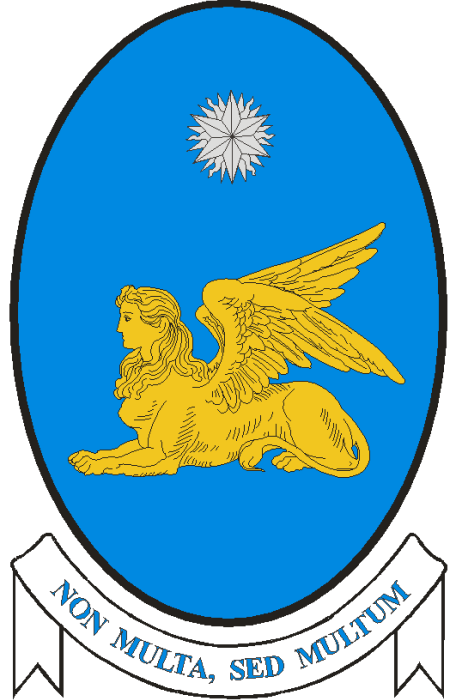
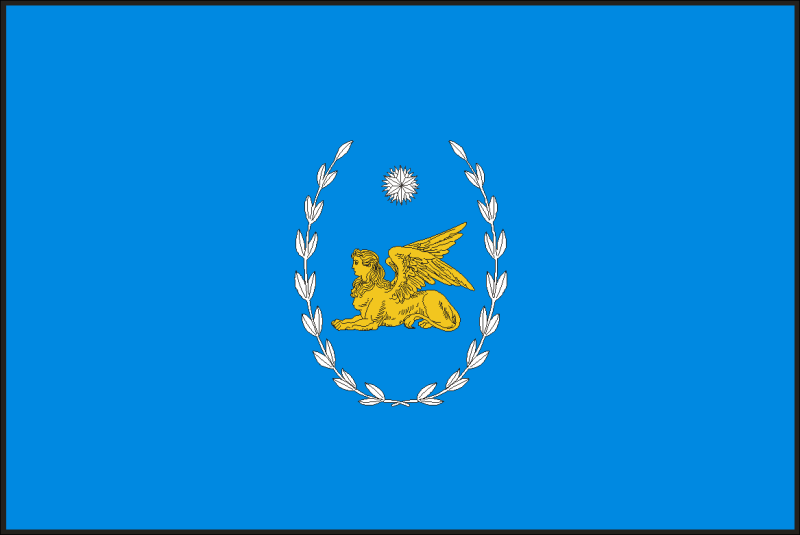
IMCS Emblem and Flag
In the oval shield, on blue, under the silver radiant star with six rays there is a lying sphinx, of Or. The motto is written on a silver ribbon with blue capital letters: "NON MULTA, SED MULTUM" (Not many, but much). […]